International education may operate increasingly through digital platforms, online meetings and virtual networks, but some of its most important relationships are still built face to face.
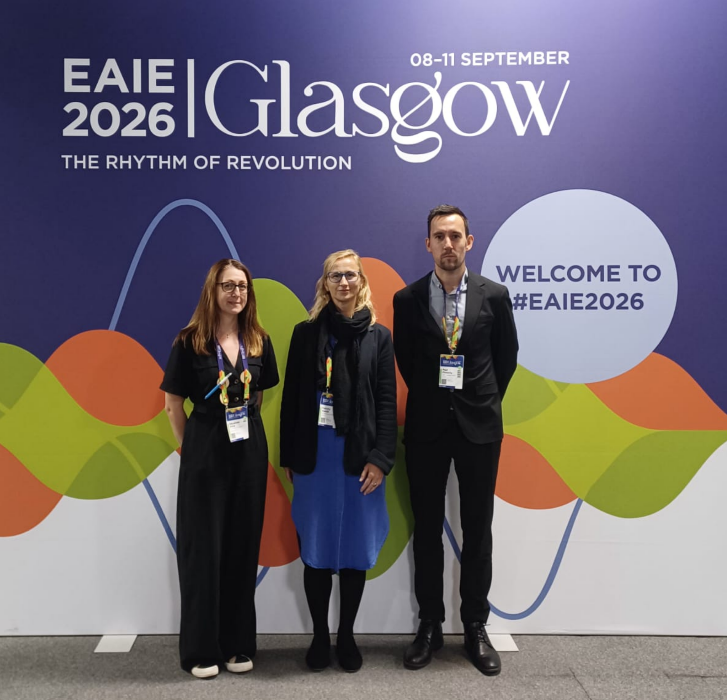
That was particularly evident at EAIE 2026 in Glasgow, where international education professionals from across Europe and beyond came together from 8–11 September for four days of professional learning, discussion, networking and institutional cooperation.
Representing both their own training centres and Erasmus Courses Ireland were Paul Finnerty of Atlas Language School, Felicity Hamill of Emerald Cultural Institute and Liz Price of CES – Centre of English Studies.
Their time in Glasgow combined conference sessions with meetings involving European universities, International Relations professionals and Erasmus+ coordinators, providing valuable opportunities to discuss future collaboration, professional development and KA1 staff mobility opportunities in Ireland.
For Erasmus Courses Ireland, participation in events such as EAIE is not simply about being present at an international conference. It is an important part of developing the relationships that underpin successful European mobility.
EAIE 2026: Responding to a Changing International Education Landscape
The annual conference of the European Association for International Education is one of the major meeting points for professionals working in international higher education.
Under the 2026 theme “The Rhythm of Revolution”, the Glasgow programme included more than 240 sessions and activities, structured around areas including European-funded programmes, partnerships, student and staff mobility, leadership and strategy, social responsibility, teaching and learning, and research on internationalisation.
The programme reflected many of the issues currently facing institutions across Europe: how internationalisation is changing, how institutions can strengthen partnerships, how mobility can create greater impact, and how emerging technologies such as AI are influencing international education.
One workshop, for example, explored the responsible use of AI within International Relations Offices, including its potential role in mobility, communication, inclusion and cooperation between universities. Elsewhere, sessions examined the future development of Erasmus+, international student mobility and the relationship between Erasmus+ experiences and employability.
These are not isolated topics. Together they point towards a broader change in how institutions are approaching international mobility: moving beyond participation numbers towards quality, skills, institutional impact and sustainable cooperation.
Why Face-to-Face Networking Still Matters
International partnerships rarely begin with a form or a database. They usually begin with a conversation.
Digital communication makes it possible to maintain relationships across countries with extraordinary ease, but face-to-face meetings still provide something different. They allow institutions to understand one another’s priorities, ask detailed questions, establish trust and identify areas where there is a genuine basis for cooperation. This is particularly important within Erasmus+.
A university may be seeking professional-development opportunities for administrative or academic staff. A VET institution may want to develop international mobility around particular skills. An International Relations team may be looking for reliable partners in another European country. Those needs are difficult to understand through a generic course listing alone.
Meeting in person gives both sides the opportunity to discuss what the institution is trying to achieve, rather than immediately focusing on a particular programme or mobility. That distinction matters.
Strong Erasmus+ mobility should start with institutional and participant needs and then identify the professional development, host organisation or partnership that best responds to them.
From Networking to Meaningful European Partnerships
EAIE therefore provides value at several levels.
There is the formal professional-development programme, where participants can explore emerging developments and learn from colleagues working across different international education systems.
There is also the less formal but equally important exchange that happens between sessions, during meetings and through the conference network.
For Paul, Felicity and Liz, Glasgow provided opportunities to meet both new and existing European contacts, including university representatives and Erasmus+ coordinators interested in international collaboration and staff development.
These conversations can form the starting point for future activity: a staff mobility, a professional-development programme, an institutional visit or a longer-term European partnership.
They also allow relationships that may have existed primarily through email and online meetings to become stronger.
In international education, that human connection remains important. Institutions are not simply selecting destinations; they are entrusting partners with the professional experience of their staff and, in many cases, the experience of their learners.
Erasmus+ Staff Mobility and Professional Development in Ireland
Erasmus+ supports training periods abroad for staff working in Higher Education, while staff training opportunities are available more broadly across education in both teaching and non-teaching roles. Activities can include professional-development courses, job shadowing, observation and other competence-building opportunities.
Ireland can play an important role within that European mobility landscape. Through Erasmus Courses Ireland, institutions can access a network of established education providers across Dublin, Cork and Galway, offering professional development in areas ranging from language and professional communication to digitalisation and AI, methodology, inclusion, wellbeing and sustainability.
For universities and VET institutions in particular, the opportunity is broader than attending an individual course. Mobility can support professional competence, internationalisation, institutional cooperation and the development of international networks.
The important question is increasingly:
How can an individual mobility contribute to something larger when the participant returns home?
Creating Institutional Impact Through Mobility
Professional mobility is most valuable when knowledge travels in both directions. Participants bring their own experience into an international learning environment, exchange approaches with colleagues from other countries and return with new ideas, perspectives and professional relationships.
Institutions can increase that impact by connecting mobility to organisational priorities and encouraging participants to share what they have learned. A staff member developing greater digital capability might subsequently support colleagues. New knowledge around inclusion or sustainability might influence departmental practice. Professional English development can strengthen an institution’s ability to participate in international projects. A relationship formed during mobility may develop into an institutional partnership.
The result is a progression from:
individual professional development → knowledge sharing → institutional development → European cooperation.
This thinking is also central to the Erasmus+ Coordinator Staff Weeks being hosted by Erasmus Courses Ireland in November 2026, which combine professional learning, peer exchange and partnership development for VET, Higher Education and school-sector coordinators. Learn more here Erasmus Staff Weeks.
Why International Education Events Are Worth Attending
Conferences require time, travel and resources, so institutions understandably need to see a clear professional return. For organisations involved in international education, however, events such as EAIE create something that is difficult to reproduce remotely: concentrated access to knowledge, people and potential partners from across the international education community.
Attendance can help institutions:
- understand emerging priorities and developments in international education;
- exchange good practice with peers working in other systems;
- maintain existing institutional relationships;
- identify potential partners and mobility opportunities;
- develop new professional networks;
- understand directly what European institutions need from their international partners.
Perhaps most importantly, they create the space for conversations that would otherwise never happen. A short meeting in Glasgow may become a staff mobility in Ireland. A discussion between International Relations colleagues may lead to a new partnership. An exchange of ideas may influence how an institution approaches its own internationalisation strategy. Those outcomes are difficult to predict in advance, but they are precisely why professional networks matter.
Continuing the Conversations from Glasgow
For Erasmus Courses Ireland, EAIE 2026 was therefore both a learning opportunity and an important opportunity to strengthen Ireland’s connections within the wider European education community.
We are proud that Atlas Language School, Emerald Cultural Institute and CES – Centre of English Studies represented our network in Glasgow and contributed to conversations with colleagues from universities and institutions across Europe.
The next stage is the most important one: continuing those conversations, developing relationships and identifying where shared priorities can lead to meaningful future cooperation. Because behind every successful mobility programme or European partnership there is ultimately something very simple:
People and institutions taking the time to understand one another and deciding to work together.