Erasmus+ mobility is often discussed in terms of travel, training and international experience, but for education professionals its value can be much broader. Time spent in another institution or another country offers an opportunity to look beyond the routines of everyday working life and to consider familiar professional questions from a different perspective. For teachers, lecturers, vocational education professionals, Erasmus+ coordinators, managers and support staff, this kind of mobility can create something that is increasingly difficult to find within busy institutions: sustained time for professional reflection, informed discussion and genuine exchange with colleagues working in different educational contexts.
This is particularly relevant at a moment when education systems across Europe are responding to considerable change. Digitalisation and artificial intelligence are influencing teaching, assessment and administration; inclusion and accessibility remain central concerns; institutions are under pressure to internationalise while demonstrating meaningful impact; and teachers and academic staff are being asked to adapt to new learner expectations, technologies and ways of working. In that environment, professional development cannot consist only of receiving new information. It also needs to provide opportunities to compare practice, question assumptions and learn from the experience of others. Well-designed Erasmus+ Staff Weeks can provide precisely that space.
Staff Weeks as a Form of Professional Learning
The most useful way to think about an Erasmus+ Staff Week is not simply as a programme of activities, but as a temporary professional learning community. Participants arrive with very different backgrounds, responsibilities and institutional cultures, yet often discover that many of the challenges they face are remarkably similar. A secondary teacher working with multilingual learners, a VET mobility coordinator supporting apprentices, a university lecturer considering the role of AI in assessment and an international officer trying to build sustainable European partnerships may work in very different environments, but all are dealing with questions of engagement, change, inclusion and institutional development.
This diversity is one of the strengths of international staff mobility. Participants are not starting from zero. They bring years, sometimes decades, of professional experience with them, and a successful Staff Week recognises that experience as an important part of the learning process. Formal workshops and seminars have an essential role, but so do facilitated discussions, peer exchange, observation and the opportunity to compare how different institutions respond to similar challenges. The learning becomes reciprocal rather than one-directional, with participants contributing knowledge as well as receiving it.
For experienced education professionals in particular, this matters. Many have attended numerous conferences, courses and training sessions during their careers. What often becomes more valuable at this stage is not another sequence of presentations, but the chance to test ideas against the experience of colleagues from other countries. A professional conversation with someone working in a different system can challenge assumptions in a way that familiar internal meetings often cannot.
Why Peer Exchange Matters in Erasmus+ Staff Mobility
Peer learning is one of the most important, but sometimes underestimated, elements of Erasmus+ staff mobility. European education institutions operate within different national systems, funding structures, curricula and cultural environments, yet they regularly confront comparable problems. How do we make international mobility genuinely inclusive? How can institutions use digital tools without losing the human dimension of education? How should teachers respond to rapidly developing artificial intelligence? How can international partnerships move beyond individual projects and become part of an institution’s longer-term strategy?
There is rarely a single answer to questions such as these. The value of a Staff Week lies partly in hearing several responses and understanding why different institutions have made different choices. A participant may encounter an approach that can be transferred directly into their own context, but equally valuable is the process of understanding why an approach works elsewhere and considering whether the principles behind it could be adapted locally.
This kind of exchange can be especially useful for Erasmus+ coordinators and international staff, whose roles often require them to work across academic, administrative and institutional boundaries. Meeting colleagues responsible for similar work elsewhere provides an opportunity to discuss practical realities that may receive little attention in formal policy documents: participant preparation, staff engagement, institutional recognition, partnership development, dissemination, inclusion and the challenge of turning individual mobility experiences into wider organisational learning.
For teachers and lecturers, the same principle applies at classroom level. Discussions around methodology, learner motivation, digital practice or inclusion become richer when participants can compare not only techniques but also the contexts in which those techniques are being used. It is this combination of professional experience and cultural perspective that distinguishes international peer learning from many forms of domestic professional development.
Learning Through Institutional Visits and Observation
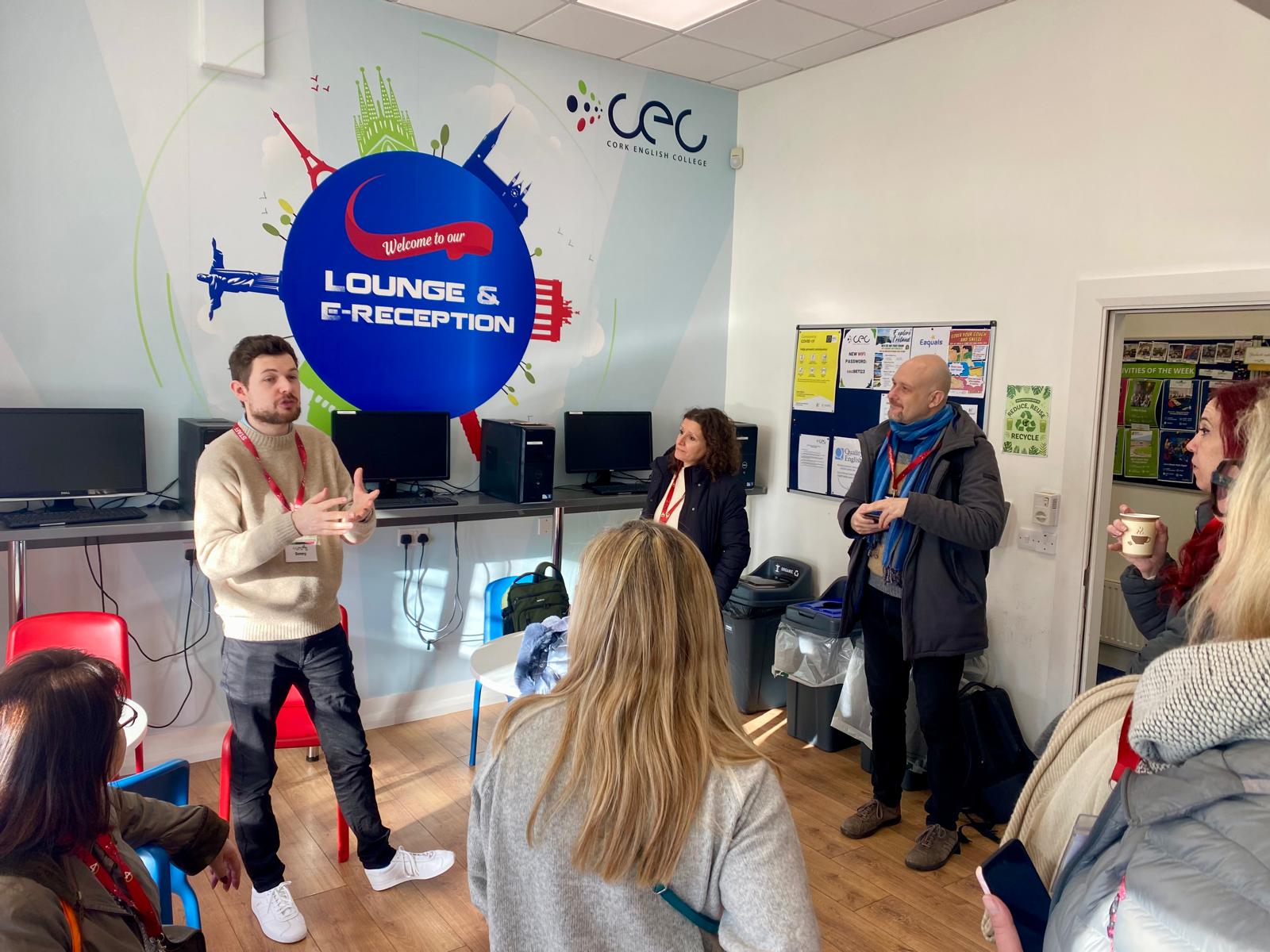
Institutional visits are another important element of Erasmus+ Staff Weeks in Ireland because they allow participants to move beyond descriptions of practice and see organisations operating in context. An institution can explain its teaching philosophy, international strategy or learner-support model in a presentation, but visiting the organisation often reveals far more. Participants see how staff interact, how students use the learning environment, how international activity is integrated into everyday operations and how an organisation’s values translate into practical decisions.
The most interesting observations are not always the most obvious ones. A participant may be struck by the way an institution introduces new students, communicates with learners, organises collaborative spaces or involves administrative staff in international activity. These details can prompt useful conversations precisely because they are practical. Instead of discussing education only at policy level, participants are able to ask how things actually work: who is responsible, what difficulties arose, what changed over time and what staff or students thought of the process.
For academic and education professionals, observation also creates an opportunity to reflect on their own institutional culture. Practices that seem completely normal within one organisation can suddenly become visible when compared with another. International visits therefore do not necessarily lead participants to conclude that another system is better. Often they lead to a more nuanced understanding of why their own institution works as it does, which practices are worth retaining and where there may be room for change.
The Value of Stepping Outside the Institution
One of the less tangible benefits of Erasmus+ professional development is distance. Education professionals spend much of their working lives responding to immediate needs: teaching, meetings, assessment, student support, reporting, projects, administration and deadlines. Even institutions that value professional development can struggle to provide staff with uninterrupted time to think about their work in a broader way.
Mobility changes the context. By stepping temporarily outside the institution, participants gain the space to think differently about it. Conversations with colleagues from other countries can make familiar problems appear less fixed and can introduce alternatives that might not emerge within an internal discussion. This is especially valuable for professionals involved in organisational change, internationalisation or programme development, where perspective is often as important as technical knowledge.
The social and cultural dimension of mobility contributes to this process as well. Informal conversations during coffee breaks, meals, city visits or journeys between institutions are not separate from the professional experience; they are often an important part of it. These are the moments when participants move beyond formal introductions and begin to discuss the realities of their work more openly. Future partnerships may emerge from these conversations, but so too can smaller forms of professional support: the exchange of resources, future online meetings, introductions to colleagues or simply an ongoing contact with someone facing similar challenges.
Connecting Different Areas of Education
There is an understandable tendency in professional development to organise participants by sector. Primary and secondary teachers have different priorities from university lecturers, and vocational education professionals operate within structures that may be quite different from those of language schools or higher education institutions. Some differentiation is therefore essential, particularly when exploring methodology, learner needs or sector-specific mobility.
At the same time, many of the most important issues facing European education now extend across those boundaries. Digital transformation, artificial intelligence, inclusion, staff wellbeing, sustainability, internationalisation and learner engagement are not confined to one sector. Bringing professionals from different backgrounds into conversation around these broader themes can generate perspectives that would be difficult to encounter within a single professional community.
This is also where carefully structured Staff Weeks can add value. The programme does not need to make every activity identical for every participant. Sector-specific discussions can sit alongside shared sessions, institutional visits and peer exchange. The objective is not to erase the differences between educational contexts but to use them productively, allowing participants to understand how other parts of the education system are responding to common pressures and opportunities.
From Individual Mobility to Institutional Impact
The long-term value of an Erasmus+ Staff Week depends largely on what happens after participants return home. Mobility may begin as an individual professional experience, but its wider impact is created through reflection, dissemination and application. Participants may share an approach with colleagues, introduce a resource or digital tool, reconsider an existing process, develop a new mobility partnership or contribute ideas to future institutional planning.
Not every outcome needs to be large or immediately measurable. In education, change often develops incrementally. A conversation during a Staff Week may lead to a small adjustment in classroom practice. An institutional visit may influence how a department supports incoming international students. A connection made during a peer-exchange session may develop into a future Erasmus+ partnership. Several months later, the original mobility may no longer be visible as the starting point, but it has still contributed to institutional learning.
For this reason, good Staff Weeks should create space for participants to think not only about what they have learned, but about what is relevant to their own organisation and how that learning might be shared. Reflection and transfer are not additions to the programme; they are part of the professional learning process itself.
Erasmus+ Staff Weeks in Ireland
Ireland offers a particularly interesting environment for this type of international professional exchange. English provides a shared working language for participants from across Europe, while the country’s education and training sector offers opportunities to explore different approaches to language learning, vocational education, internationalisation and professional development.
Erasmus Courses Ireland works with education and training centres in Dublin, Cork and Galway, enabling participants to experience different institutional and regional contexts within one programme. Rather than remaining in a single training environment, participants can meet professionals working in different organisations, visit centres, take part in seminars and compare approaches across locations.
Our Erasmus+ Staff Weeks in Ireland are designed around this principle of exchange. The programmes include professional development and institutional visits, but equal importance is placed on discussion, peer learning and the opportunity for participants to contribute their own experience. Programmes for primary and secondary education reflect the priorities of those sectors, while activities for VET and higher education professionals address their own institutional and mobility contexts. Across both, the underlying purpose remains the same: to create meaningful opportunities for European education professionals to learn from one another.
More Than Professional Development Abroad
The lasting value of international staff mobility does not necessarily lie in a single presentation, technique or resource. It often lies in the accumulation of smaller experiences: seeing another institution at work, hearing how a colleague elsewhere has approached a familiar problem, recognising that a challenge is shared across countries, or discovering a professional connection that continues after the mobility has ended.
At its best, an Erasmus+ Staff Week creates the conditions for those experiences to happen. It brings professionals out of their usual institutional environment, gives them time to engage seriously with colleagues from elsewhere and creates a setting in which professional knowledge can move in both directions.
For education institutions, that matters. Internationalisation is most valuable when it is not treated simply as an activity that takes staff abroad, but as a means of bringing new perspectives, relationships and ideas back into the organisation. Erasmus+ staff mobility can play an important role in that process, helping institutions remain outward-looking, reflective and connected to the wider European education community.
Erasmus Courses Ireland will host its next Erasmus+ Staff Weeks in Dublin, Cork and Galway in November 2026, with separate programmes for Primary and Secondary Education and for VET and Higher Education professionals.